History
‘A high-quality history education will help pupils gain a coherent knowledge and understanding of Britain’s past and that of the wider world. It should inspire pupils’ curiosity to know more about the past. Teaching should equip pupils to ask perceptive questions, think critically, weigh evidence, sift arguments, and develop perspective and judgement. History helps pupils to understand the complexity of people’s lives, the process of change, the diversity of societies and relationships between different groups, as well as their own identity and the challenges of their time.’
Children in EYFS develop an early sense of history through role play and stories, learning about people who help them and the roles they play in society, while beginning to recognise similarities and differences between the past and present in relation to their own experiences, including learning about significant figures such as Neil Armstrong and Mary Anning. As pupils move through KS1 and KS2, our History curriculum—broad and carefully sequenced through CUSP—builds cumulative understanding of chronology, cause and consequence, and connections across time periods. Retrieval practice and deliberate tasks support long‑term retention, and regular revisiting of key concepts helps pupils form a coherent mental timeline rather than isolated facts. Vocabulary is taught progressively from Year 1 to Year 6, enabling pupils to confidently understand and discuss important historical events, people, and places, because the more they know about the past, the better prepared they are for the future
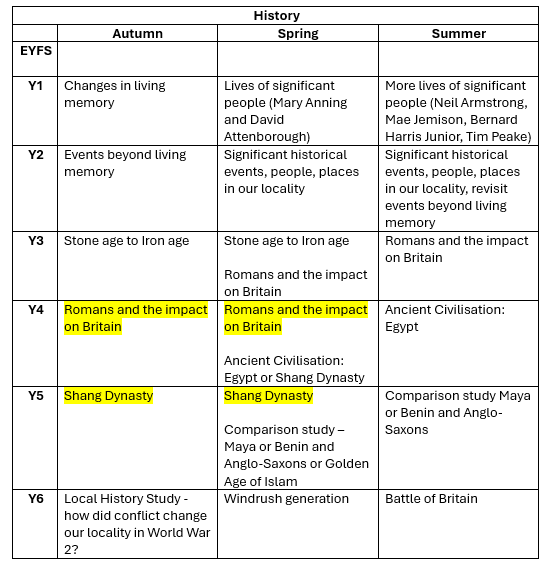
As we transition from our previous history curriculum to our current, some areas are adapted these have been highlighted in yellow.