Geography
‘A high-quality geography education should inspire in pupils a curiosity and fascination about the world and its people that will remain with them for the rest of their lives. Teaching should equip pupils with knowledge about diverse places, people, resources and natural and human environments, together with a deep understanding of the Earth’s key physical and human processes. As pupils progress, their growing knowledge about the world should help them to deepen their understanding of the interaction between physical and human processes, and of the formation and use of landscapes and environments. Geographical knowledge, understanding and skills provide the frameworks and approaches that explain how the Earth’s features at different scales are shaped, interconnected and change over time.’
Our approach to Geography begins in the Early Years Foundation Stage (EYFS), where children explore their immediate environment through play, observation, and first‑hand experiences. They develop early knowledge about places, people, culture, and the natural world, forming the foundations needed to make sense of more complex ideas later on. As pupils enter KS1 and KS2, our Geography curriculum—taught through the carefully sequenced CUSP scheme—builds cumulatively on this early understanding. Learning is structured to strengthen pupils’ grasp of spaces, places, and processes, and to help them make meaningful connections between different geographical concepts over time. Retrieval practice and deliberate tasks support long‑term retention, ensuring pupils develop a coherent understanding of the world rather than fragmented knowledge. Vocabulary is introduced progressively from Year 1 to Year 6, enabling pupils to confidently describe and discuss key geographical ideas—because the more securely they understand the world around them, the better equipped they are to navigate it.
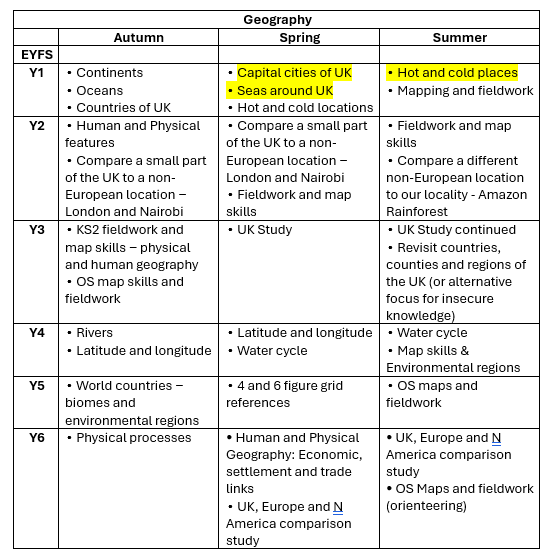
As we transition from our previous history curriculum to our current some areas are adapted these have been highlighted in yellow.